

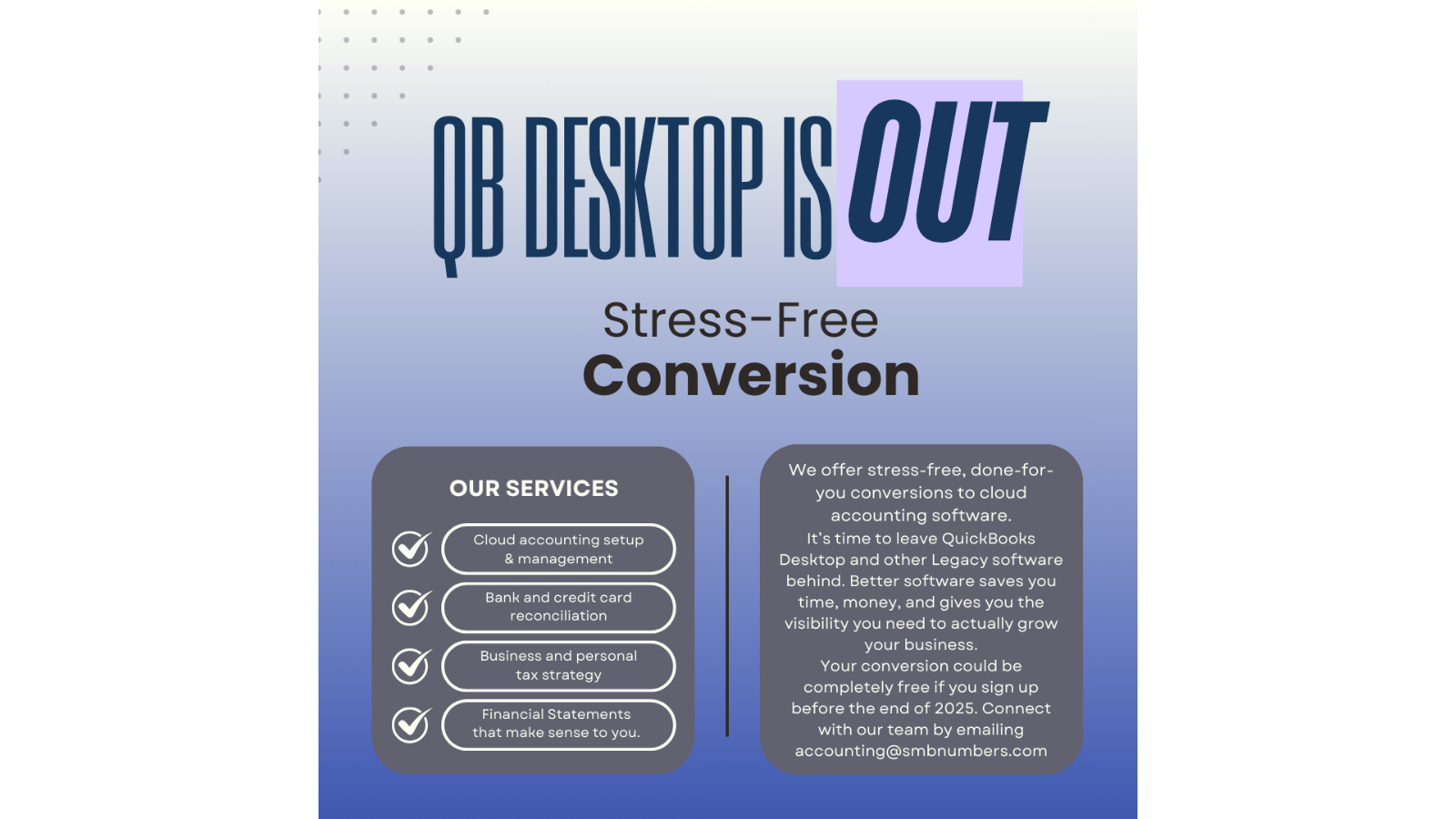
The Hidden Cost of Loyalty: Why QuickBooks Desktop is Now Your Biggest Business Risk
QuickBooks Desktop is shutting off features every month, now is the time to move, before your data gets locked into a legacy system you can’t get it out of.
For years, QuickBooks Desktop (QBDT) was the undisputed champion of small business accounting. It worked, it was familiar, and it sat securely on your server. But in 2025, loyalty to this outdated infrastructure is translating into unnecessary risks and measurable lost profits.
As an accountant with a focus on real-time growth strategy, I’m here to tell you: your desktop solution is no longer an asset; it is a liability.
If you are currently running your financials on QBDT, you need to read this and schedule a strategy call today.
1. Data Delay is a Profit Delay: Managing in the Rearview Mirror
The most damaging aspect of QBDT isn't its interface—it's the data latency.
In a dynamic economy, waiting for your data is financially crippling. If your financial processes require manual file transfers, nightly backups, or delayed data entry, you are experiencing significant financial blind spots.
The Problem: You’re waiting until the 15th, 20th, or even the 30th of the month to compile a full, accurate picture of your prior month's performance.
The Cost: This means every critical decision—whether to hire a new employee, invest in inventory, launch a new service, or adjust pricing—is based on old information. Your competitors using cloud solutions are making these adjustments today based on yesterday’s sales data. This daily lag is costing you margin and market share.
Real-time visibility is the key to managing cash flow and optimizing tax strategy. QBDT simply cannot deliver this level of instant, actionable intelligence.
2. The Unacceptable Cost of Security and Maintenance
Many business owners believe QBDT saves them money by avoiding cloud subscription fees. What they fail to see is the compounding, hidden cost of maintaining a localized system:
The IT Headache
You are paying for:
Physical server hardware, cooling, and space.
Costly IT technician hours for server crashes, connection issues, and patching.
Manual, often inconsistent, backup routines that are prone to human error.
The Security Risk
When you rely on QBDT, the responsibility for data security is 100% on you. One malware attack, one hardware failure, or one forgotten backup can wipe out years of financial history. The cost of a major data breach or file corruption dwarfs any annual subscription fee. Cloud platforms invest millions annually in security, redundancy, and automatic backups—a defense mechanism no small business can replicate on their own server.
3. Scalability: QBDT is Capping Your Growth Potential
Modern business is mobile, collaborative, and fast. QBDT is none of these things.
QBDT forces your operations to revolve around a physical, fixed location. This creates immediate friction points that hinder growth:
Restricted Access: Need to check inventory levels or approve a major payment while traveling? With QBDT, you are often blocked or forced through clunky, insecure remote desktop connections.
Slow Collaboration: Working with your accountant (or internal finance team) is inefficient. We have to log in remotely, wait for data syncs, or request files, slowing down reporting and proactive tax planning.
Limited Integration: QBDT struggles to connect natively with the modern, niche business apps (CRM, e-commerce platforms, advanced inventory tools) that are essential for scaling today's operations.
The Solution: A Strategic Shift to the Cloud
Migrating to a solution like Xero is not an expense—it’s a necessary strategic investment.
It immediately delivers:
Instant Visibility: Bank feeds and transactions are live, giving you true, real-time cash position and P&L data, allowing you to react immediately.
Bulletproof Security: Automatic backups, bank-level encryption, and 24/7 monitoring managed by experts.
Freedom to Scale: Access financials from any device, anywhere, and collaborate with your team and advisors seamlessly.
Stop settling for a competitive disadvantage. The cost of inaction far outweighs the cost of transition.
Book a Review now to see if you’re eligible for a free cloud conversion.
Why Year-End Tax Planning is Your Financial Superpower
It’s easy to put off thinking about taxes until the last minute, but waiting until January to start thinking about your previous year's taxes is like trying to close the barn door after the horse has bolted. The most powerful moves you can make to lower your tax bill and boost your financial health happen before the year ends. This is why proactive tax planning is so crucial.
What Exactly is "Tax Planning"?
Think of tax planning not as simply filling out forms, but as a financial strategy session. It’s the process of looking ahead at your income, expenses, and investments for the entire year to find legal ways to reduce the amount of money the government takes in taxes.
The goal isn't just to calculate your tax bill; it's to strategically minimize it and make sure you're using every opportunity the tax code offers to save and invest.
Why is Tax Planning Your Financial Superpower?
1. Keep More of Your Hard-Earned Money 💰
This is the big one. Effective planning identifies deductions and credits you qualify for.
A deduction reduces the amount of income that is subject to tax.
A credit is even better—it reduces your tax bill dollar-for-dollar.
By maximizing these, you ensure you're not paying a penny more than required.
2. Avoid Tax-Time Surprises (and Penalties!) 😰
No one likes an unexpected bill. By reviewing your situation mid-year or near the end, you can get an accurate estimate of what you'll owe. This allows you to:
Adjust your paycheck withholdings.
Set aside cash now so you're not scrambling when the tax deadline hits.
Avoid penalties for underpaying estimated taxes throughout the year.
3. Align Your Taxes with Your Life Goals 🏡
Did you start a new business? Get married? Have a baby? Start saving for a house or retirement? These major life events have significant tax implications. Planning helps you adjust your strategy to take advantage of new tax benefits (like the Child Tax Credit) or structures (like setting up a SEP IRA for your business). It ensures your financial plan and your tax strategy are working together, not against each other.
Why the Year-End Deadline is Critical: The "Use It or Lose It" Window
Once December 31st passes, most of the best, most powerful tax-saving actions are simply gone. You lose the chance to apply them to your current year's taxes.
Here are three common year-end moves that must be made before the clock strikes midnight:
1. Maxing Out Retirement Savings 🛡️
You can often contribute to certain retirement accounts (like a Traditional or Roth IRA) until the April tax deadline. However, employer-sponsored plans like your 401(k) must be funded by December 31st.
The benefit: Contributions to accounts like a Traditional 401(k) are typically taken out of your pay before taxes, instantly lowering your taxable income for the year. This is one of the easiest ways to save on taxes and secure your future.
2. Tax-Loss Harvesting for Investors 📉📈
If you've sold investments this year for a gain (a profit), you likely owe tax on that profit. Tax planning allows you to look at your portfolio and sell other investments that have lost value (a loss).
The benefit: You can use those losses to "cancel out" your investment gains, reducing or eliminating the tax you'd otherwise owe. This must be done before year-end!
3. Charitable Giving 🎁
If you are planning to make a charitable donation to a qualified organization, the donation must be completed by December 31st to count as a deduction for the current tax year.
The benefit: A charitable deduction lowers your taxable income. For those who can itemize their deductions, it can lead to substantial savings. This is a great way to support causes you care about while reducing your tax bill.
The takeaway? Don't let valuable tax-saving opportunities slip away with the calendar year.

Stop Losing Money: 3 Common Job Costing Mistakes to Avoid
You track your crew's total pay, but you don't allocate their hours correctly. For example, a crew is paid for 40 hours, but 5 of those hours were spent driving, doing shop maintenance, or working on a different, smaller job.
Poor job costing doesn't just reduce your profit; it actively misleads you, leading to disastrous long-term decisions that can sink your business. Here are the three most common mistakes construction owners make and their hidden financial costs.
Mistake 1: Ignoring Payroll Allocation
The Error: You track your crew's total pay, but you don't allocate their hours correctly. For example, a crew is paid for 40 hours, but 5 of those hours were spent driving, doing shop maintenance, or working on a different, smaller job.
The Cost: You are overstating the labor cost for the main project. This makes your successful job look less profitable than it is, and your future bids for similar work will be unnecessarily high, causing you to lose competitive jobs.
Mistake 2: Lumping Overhead Costs into Jobs
The Error: You assign too much of your office rent, administrative staff salaries, and general utilities (your overhead) directly to a specific job.
The Cost: This inflates the job's total costs, making a profitable job appear to have a lower margin. When it comes time to bid on the next job, you mistakenly build this inflated cost into your estimate, leading to bids that are too high, and ultimately, you lose the work. Overhead must be handled separately—or allocated via a calculated burden rate—not dumped randomly.
Mistake 3: Tracking ONLY Materials and Subs
The Error: You focus only on the big-ticket items—lumber, concrete, and sub payments—and forget to track smaller, direct job costs that still chew away at profit.
The Cost: You miss tracking costs like permits, engineering fees, temporary site utilities, disposal fees, and small tool purchases used specifically on that job. These costs get buried in "Admin" or "General Expenses," giving you an overly optimistic view of your job's profitability. When you don't know your true costs, you underbid future work, leading to a vicious cycle of low margins.
🛑 When to Bring in Professional Help
If any of the following are true, it’s a clear sign you need to partner with an accounting firm specializing in construction:
You're 90+ Days Behind: If your books aren't closed by the 15th of the month, your data is too old to be useful for active decision-making.
Your Labor is a Black Box: You can't calculate the exact labor cost per hour for a specific job, including payroll taxes, workers' comp, and benefits.
Your Profit Margin is Shrinking: You are busier than ever, but the money in your bank account isn't growing proportionally.
We specialize in setting up the robust job costing systems that construction firms need. Would you like to schedule a free 15-minute consultation to review your current chart of accounts and see how we can immediately improve your job costing accuracy?
Book A Call Now

Stop Guessing: Why Monthly Job Costing is Your Construction Business's Secret Weapon
Think of your entire business like a pizza. Job costing is the construction equivalent of breaking down that pizza. It's the process of tracking all expenses—materials, labor, subcontracts, and overhead—to a specific project, or "job."
If you own a construction business, you're a master builder. But when it comes to the numbers, do you feel like you're just hoping you made money at the end of the year? It’s time to stop the guesswork.
The Pizza Analogy: What is Job Costing?
The difference between a busy construction company and a truly profitable one isn't the size of the jobs—it's how well you track your costs.
Think of your entire business like a pizza. When you buy a pizza, you care about the total price. But for the pizzeria owner, they need to know the exact cost of every single ingredient: the dough, the sauce, the cheese, and the pepperoni. If they sell a slice for $3 and the ingredients cost $3.50, they are losing money, no matter how many pizzas they sell.
Job costing is the construction equivalent of breaking down that pizza. It's the process of tracking all expenses—materials, labor, subcontracts, and overhead—to a specific project, or "job."
Why Waiting is a Financial Mistake
Why should you do this monthly? If you wait until the end of the year, it's like performing a post-mortem—you find out why the job lost money, but you can't save the project.
Doing this monthly allows you to course-correct while the job is active, before minor cost overruns become major, unrecoverable losses. The goal is to compare your Budgeted Costs to your Actual Costs for every job right now.
Immediate Action: Get Surgical with Your Expenses
You don't need a massive software overhaul to start seeing results. You need a better system for categorizing your spending.
Action Step 1: Upgrade Your Chart of Accounts.
Your Chart of Accounts (the list of all your expense categories) must be detailed enough to tag specific costs. Stop using general accounts like "Job Expenses." Instead, use specific accounts:
Direct Labor - Wages
Materials - Lumber/Steel/Concrete
Subcontractor Costs
Equipment Rental/Lease
Action Step 2: Implement Mandatory Job Tagging.
Every single dollar in and out of your business must be tagged to a specific job (e.g., Project #101, Project #102).
Invoices: Tag all revenue to the correct job.
Bills/Receipts: When paying a supplier, ensure the expense is tagged to the correct job. If a receipt covers multiple jobs, the cost must be allocated correctly.
By implementing this surgical approach to your expenses, you lay the groundwork to see which jobs are truly making you money and which are silently draining your profits.
Get in contact with us today to maximize your 2025 profitability!

Maintaining S-Corp Status: State & Local Compliance Made Simple
S-Corp owners, beware! 🏛️ State and local rules can trip you up—even if your federal filings are perfect. Discover how to stay compliant everywhere you operate with SBM Numbers Accounting. 👇
Electing S-Corporation status is a federal tax decision, but you still have to play by state and local rules. Each state has its own requirements—and missing them can put your S-Corp at risk.
👉 So what? State rules vary widely and can be overwhelming. That’s why you need a professional—not just software—to keep your S-Corp compliant everywhere you operate.
1. File State Annual Reports & Pay Franchise Taxes
Most states require annual reports and fees to maintain good standing.
Some also have franchise or corporate-level taxes—even if you’re an S-Corp.
Not sure what your state requires? Talk to a SBM Numbers Accounting expert.
2. Keep Up With Business Licenses & Permits
Local governments often require business licenses or occupation permits. Missing a renewal could mean fines—or even losing the right to operate legally.
Stay worry-free. We’ll track deadlines and renewals for you.
3. State Recognition of S-Corp Status
Some states automatically recognize your federal election. Others require a separate state-level S-Corp election. Miss this step, and your state may tax you as a regular corporation.
Let SBM Numbers handle your multi-state compliance.
4. Maintain Corporate Formalities
To protect your liability shield, you must treat your corporation as separate from yourself:
Hold and document annual meetings
Keep stock ledgers updated
Separate personal and business finances
Download our compliance checklist to make sure you’re covered.
5. Stay Ahead of Deadlines
From state filings to payroll taxes, deadlines can sneak up quickly. Proactive scheduling and professional monitoring keep you penalty-free.
Want reminders you’ll never miss? Partner with SBM Numbers.
State & local compliance can feel like a maze. Don’t risk fines or losing your good standing. With SBM Numbers, you’ll have experts monitoring every requirement so your business stays protected.

Maintaining S-Corp Status: Federal Compliance Essentials Every Owner Must Know
Got an S-Corp? 🚨 Don’t risk penalties! Learn the 4 federal rules every owner must follow—from paying yourself fairly to staying audit-ready. SBM Numbers Accounting makes compliance easy. 👇
Electing S-Corporation status is just the beginning. To keep your tax and liability benefits, you must comply with ongoing federal rules. Missing even one requirement can jeopardize your S-Corp status, lead to penalties, or expose your personal assets.
👉 So what? S-Corp compliance is complex. That’s why having a professional accountant by your side helps with peace of mind and financial protection.
1. Pay Shareholder-Employees a Reasonable Salary
The IRS closely watches S-Corps to see if owners are paying themselves too little of a salary.
You must pay yourself a “reasonable” wage, similar to what someone in your role would earn elsewhere.
Wages must go through payroll, with taxes withheld and reported.
Need help setting a fair salary and running payroll? Book a consultation with SBM Numbers today.
2. File Federal Tax Returns & Issue K-1s
Every year, your S-Corp must:
File Form 1120-S by March 15 (or request an extension).
Prepare and distribute K-1s to shareholders so they can file their personal returns.
Late filings = IRS penalties + potential loss of S-Corp status.
Don’t risk penalties. Let our team handle your S-Corp filings.
3. Maintain Eligibility Requirements
To remain an S-Corp, you must follow IRS rules:
100 or fewer shareholders
Only U.S. citizens/residents, estates, or certain trusts as shareholders
Only one class of stock (same economic rights for all shares)
One mistake here could end your S-Corp election.
Unsure if your S-Corp still qualifies? Schedule a compliance review with SBM Numbers.
4. Be Prepared for IRS Scrutiny
The IRS often audits S-Corps, looking for low salaries or missing records. Proper documentation—minutes, resolutions, payroll reports—can protect you.
Work with SBM Numbers to stay audit-ready and compliant.
Federal compliance is not optional—it’s the backbone of keeping your S-Corp alive. Instead of worrying about deadlines and IRS rules, let SBM Numbers Accounting manage the details so you can focus on growing your business.

From $184K to $3.4M: A Real-Life Story of Financial Transformation
From $184K to $3.4M — in Just Two Years 🚀
One small business went from good to incredible after a few smart financial moves. By cleaning up their books, cutting hidden costs, and adjusting expenses, their net income jumped from $184K to $3.4M.
Smart strategy. Real results.
👉 See how they did it.
This is the kind of story that gets us excited.
A few years ago, we began working with a small business owner who was doing well, but not great. Their net income hovered around $184,000. They were working hard, but their business was leaving money on the table.
In just two years, we helped that same business scale their net income to an incredible $3.4 million. The best part? The owner was able to take home nearly $2 million that year.
This massive transformation didn't happen by accident. It was the direct result of making smart, strategic adjustments based on a deep dive into the numbers.
Here’s a look at how we did it.
Step 1: Cleaning Up the Financial House
You can’t manage what you don’t measure. Our first step was to take a hard look at their bookkeeping. We quickly realized their financial records were a mess, making it impossible to see where their money was truly going. By cleaning up their books and establishing a system for accurate reporting, we gave them a clear, real-time picture of their financial health.
This foundational work was the key that unlocked everything else.
Step 2: Finding $100,000 in Hidden Expenses
With accurate books, we were able to dig in and find what was holding their profitability back. We uncovered over $100,000 in hidden expenses they didn't even know existed. This included outdated subscription services, inefficient vendor contracts, and other unnecessary costs that had been quietly eating away at their bottom line.
By eliminating these blind spots, we put that money back where it belongs: in the business and in the owner’s pocket.
Step 3: Shifting from Fixed to Variable Costs
The final piece of the puzzle was a strategic adjustment to their cost structure. We worked together to shift some of their expenses from fixed costs (which they paid no matter what) to variable costs (which only increased with sales). This simple change gave the business much greater financial flexibility and allowed them to scale profitability faster and more efficiently than ever before.
The Power of Proactive Finances
This client's story is proof that your numbers tell a story. By digging into the data and making smart adjustments, we help small businesses like yours uncover hidden savings and unlock massive profitability.
Your financial future isn’t about chance; it’s about strategy.
Let’s make your finances work for you, not against you.